Exports
EU-Türkiye Customs Union: What EU Buyers Pay and the 4 Documents They Need
Written by Enes Ünal, Export and Business Development Lead
 Reviewed by Sertaç Öztürkcan, Co-Founder
- Related service Import Consulting
Contents7 sections
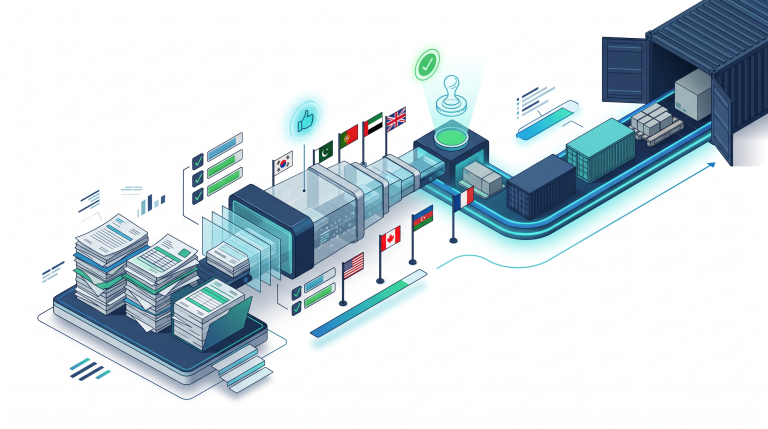
Under the EU-Türkiye customs union, industrial goods in free circulation in Türkiye enter the EU free of customs duties and quotas, provided they travel with an A.TR movement certificate. Processed agricultural products are covered too, but the EU can still charge an agricultural component on them. Basic agricultural products and coal and steel products sit outside the customs union, so they need proof of preferential origin instead.
For an EU buyer, this means two questions decide the cost of a shipment from Türkiye: which regime covers the product, and whether the supplier sends the right papers. A missing A.TR can turn a duty-free purchase into a dutiable one at the EU border.

How the EU-Türkiye customs union works for buyers
The customs union rests on the 1963 Ankara Agreement and on Decision 1/95 of the Association Council, adopted on 22 December 1995. Its final phase has applied since 1996. For the goods it covers, customs duties and quantitative restrictions are abolished, and Türkiye aligns its external tariff with the EU’s Common Customs Tariff.
The key idea is free circulation, not origin. Goods made in Türkiye qualify, but so do goods that Türkiye imported from a third country and released for free circulation. Once they are in free circulation in Türkiye, they can move to the EU on the same terms. This is why the customs union uses a movement certificate that proves customs status rather than a certificate of origin.
Which products are covered
The regime depends on the product group. Check it before you compare a Turkish offer with one from another country.
| Product group | Legal basis | Proof the buyer needs | Customs duty at the EU border |
|---|---|---|---|
| Industrial products | Customs union, Decision 1/95 | A.TR movement certificate | None for covered goods |
| Processed agricultural products | Customs union, Decision 1/95 | A.TR movement certificate | None on the industrial component; an agricultural component can apply |
| Basic agricultural products | Preferential trade regime, Decision 1/98 | Proof of preferential origin | Preferential rate or quota, where one applies |
| Coal and steel products | Free trade agreement of 25 July 1996 | Proof of preferential origin | Preferential treatment for originating goods |
For basic agricultural products and for coal and steel, the goods must originate in Türkiye under the applicable rules of origin. Goods that Türkiye only imported and re-exported do not qualify for these preferences.
The 4 documents EU buyers need from a Turkish supplier
Your customs broker in the EU files the import declaration. So that the broker can do this without delay, ask the supplier for these four documents with every shipment:
- Commercial invoice: the full product description, tariff code, value, currency and Incoterm, consistent with the contract.
- A.TR movement certificate, or proof of origin: an A.TR for industrial and processed agricultural goods; proof of preferential origin for basic agricultural, coal and steel products.
- Transport document: the CMR consignment note for road freight, the bill of lading for sea freight or the air waybill for air freight.
- Packing list: package numbers, weights and contents, so that customs can match the goods with the invoice.
Product compliance documents, such as the EU declaration of conformity for CE-marked goods, are a separate requirement. They concern product safety, not duty, and the customs union does not replace them. Our guide to export documentation shows how the supplier prepares these papers, and our page on the customs declaration in Türkiye covers the export side of the same shipment.
The A.TR certificate: what it proves and who issues it
An A.TR movement certificate proves that the goods are in free circulation in the customs union. It is not a certificate of origin, and it does not replace one where a buyer or a bank asks for origin evidence.
In Türkiye, the exporter or its customs broker prepares the A.TR electronically, the local chamber approves it and Turkish customs then endorses it. The system is coordinated by the Republic of Türkiye Ministry of Trade and run by the Union of Chambers and Commodity Exchanges of Türkiye (TOBB). The system has been used nationwide for A.TR certificates since 14 May 2018. Since 8 July 2024, EU member states have accepted A.TR certificates issued electronically by the Turkish authorities with a QR code and without a wet-ink signature, according to the European Commission.
Check each A.TR when the documents arrive. The exporter, consignee, goods description, number of packages and the customs endorsement or QR code should all match the invoice and the packing list. A mismatch found before the goods reach the border is a simple correction; found at the border, it means delay.
Common A.TR and origin mistakes on first orders
Most problems surface at the EU border, when they are slow and costly to fix. These four come up again and again with first orders:
- An A.TR issued for a product outside the customs union, such as a basic agricultural or steel product, where the preference depends on origin instead
- A goods description or quantity on the A.TR that does not match the invoice
- An A.TR used as origin evidence for a bank, a tender or a labelling claim
- Goods that Türkiye imported from a third country, treated as if they qualified for an origin-based preference
The simplest protection is contractual. Agree in the purchase contract that the supplier sends the A.TR or the origin proof with the shipping documents, and that your broker sees copies before the goods arrive.
What EU buyers still pay
Duty-free does not mean cost-free. Even when the A.TR is in order, plan for these items:
- Import VAT in the member state where the goods are released for free circulation
- Excise duty, where the product is subject to it
- Anti-dumping, countervailing or safeguard duties on specific products, which can apply to goods from Türkiye
- Carbon Border Adjustment Mechanism (CBAM) obligations for covered goods such as iron, steel, aluminium, cement and fertilisers, under the definitive regime in force since 1 January 2026, once your imports of these goods exceed 50 tonnes a year
- Customs broker, port and transport charges
CBAM applies to goods from Türkiye in the same way as to other non-EU countries; our guide to CBAM for exporters in Türkiye explains the supplier side. For trade defence measures, the EU’s TARIC database shows what is in force for each tariff code and country of origin.
When you source from Türkiye, our Import Consulting service helps you find and check suppliers, compare quotations and agree terms, including the document set each shipment needs, while your customs broker confirms the tariff treatment.
Frequently asked questions
-
Is an A.TR certificate a certificate of origin?No. The A.TR proves that goods are in free circulation in the customs union.
No. The A.TR proves that goods are in free circulation in the customs union. Origin is proved with other documents, and it matters for basic agricultural, coal and steel products.
-
Do goods from Türkiye pay customs duty in the EU?Industrial goods covered by the customs union pay no customs duty when they travel with a valid A.TR.
Industrial goods covered by the customs union pay no customs duty when they travel with a valid A.TR. For processed agricultural goods, only the industrial part of the duty is removed, so an agricultural component can still apply. Import VAT, any trade defence duties and, for covered goods, CBAM also apply.
-
Which countries are in a customs union with the EU?Beyond the customs union among its own 27 member states, the EU has separate customs unions with…
Beyond the customs union among its own 27 member states, the EU has separate customs unions with Türkiye, Andorra and San Marino. These countries do not belong to the EU Customs Union itself.
-
Does the customs union cover agricultural products?Only processed agricultural products, and an agricultural component of the duty can still apply to them.
Only processed agricultural products, and an agricultural component of the duty can still apply to them. Basic agricultural products trade under a separate preferential regime, Decision 1/98, which requires proof of origin.
FIX works from Ankara with EU buyers and importers on the supplier side of this process in Türkiye.