Exports
Export Documents Required in 2026: The Complete Checklist
Written by Enes Ünal, Export and Business Development Lead
 Reviewed by Sertaç Öztürkcan, Co-Founder
- Related service Export Consulting
- The basics What is exporting?
Contents3 sections
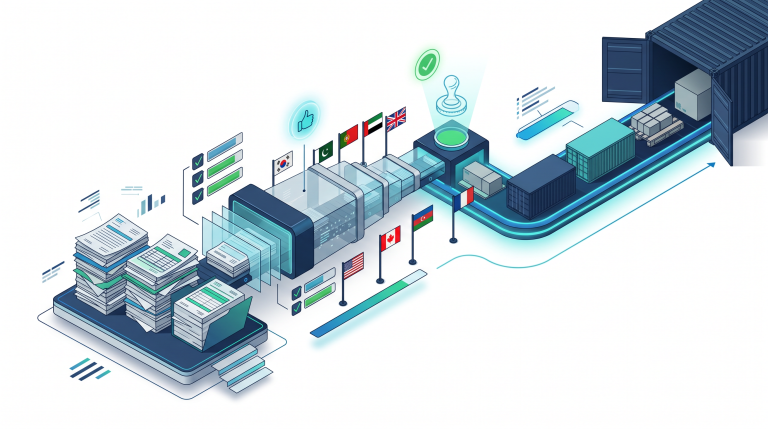
The documents required for export from Türkiye fall into two groups. The core set is the export customs declaration, commercial invoice, bill of lading and certificate of origin; the rest depend on the target market and the product. Getting them complete and accurate decides whether customs clearance runs smoothly.
A missing or incorrect document does more than delay a shipment: it can lead to customs penalties, returned goods and lasting damage to your standing with the buyer. That is why document management is one of the most critical operational steps in exporting.

Where exporters most often get their documents wrong
The document process looks simple on paper but hides plenty of pitfalls in practice. First-time exporters most often get caught out here:
- Having the certificate of origin certified somewhere other than the chamber of commerce or industry
- Unit prices that differ between the commercial invoice and the customs declaration
- Choosing the wrong type of bill of lading (master or house, MBL or HBL)
- Overlooking special certificates the target country requires (halal, CE, phytosanitary)
- Issuing EUR.1 or A.TR documents for countries with no free trade agreement
Most of these mistakes happen when the destination country’s customs rules are not checked in advance.
Which export documents are required, and when?
The table below lists the core documents on a standard export shipment from Türkiye, who issues each one and when it is required; buyers sourcing from Türkiye can use it as a checklist too.
| Document | Issued by | When required |
|---|---|---|
| Export customs declaration (EX) | Customs broker or exporter | Mandatory for every export |
| Commercial invoice | Exporter | Mandatory for every export |
| Packing list | Exporter | Mandatory for most exports |
| Bill of lading, CMR or air waybill (AWB) | Carrier or freight forwarder | Mandatory, depending on the mode of transport |
| Certificate of origin | Chamber of commerce | Mandatory if the target country requires it |
| EUR.1 or A.TR movement certificate | Customs office | Mandatory for free trade agreement (FTA) partners |
| Insurance policy | Insurance company | Mandatory under CIF/CIP delivery terms |
| Phytosanitary or veterinary health certificate | Ministry of Agriculture and Forestry | Mandatory for food and agricultural products |
| Analysis, test or CE certificate | Accredited laboratory or notified body | Mandatory depending on product type |

Movement certificates: EUR.1, A.TR or Form A?
To claim preferential tariffs under Türkiye’s free trade agreements, you need the right movement certificate:
- A.TR certificate: used only for exports to EU countries; it proves the goods are in free circulation in Türkiye.
- EUR.1 certificate: proves preferential origin for exports to FTA partners outside the EU (EFTA, Georgia, Morocco, Ukraine, etc.).
- Form A or REX statement: used for exports from developing countries under the Generalised System of Preferences (GSP).
Which document applies depends not only on the destination but also on the goods’ actual origin and the share of materials used. The Republic of Türkiye Ministry of Trade, Directorate General of Customs is the primary official source for current rules and movement certificate guides.
5 points to check when preparing export documents
- Consistency: weights, quantities and unit prices on the invoice, packing list and customs declaration must match exactly.
- Destination research: every country has its own import document requirements, so pin down the list before the order is placed.
- Order of approval: the exporter signs the certificate of origin first, then the chamber of commerce certifies it.
- Currency and language: the invoice currency must match the letter of credit currency, and documents must be in the language the destination country requires.
- Product-specific licences: defence items, dual-use goods and certain chemicals need a separate export licence.
If you are handling export documents for the first time, our Export Consulting service supports you end to end, from document preparation to customs clearance.
Not sure your documents are right? Talk to our team.
Frequently asked questions
-
Who prepares the export customs declaration?Licensed customs brokers prepare the customs declaration and file it in the customs system…
Licensed customs brokers prepare the customs declaration and file it in the customs system (BİLGE) on the exporter’s behalf. Exporters can technically do it themselves, but in practice it is left to customs brokers.
-
Where is the certificate of origin certified?The chamber of commerce or industry the exporter belongs to certifies the certificate of origin.
The chamber of commerce or industry the exporter belongs to certifies the certificate of origin. Some countries also require notarisation, an apostille or legalisation by their embassy.
-
What is the difference between a EUR.1 and a certificate of origin?A certificate of origin states which country the goods come from and can be used for exports to any country.
A certificate of origin states which country the goods come from and can be used for exports to any country. A EUR.1, by contrast, is issued to claim preferential tariffs under Türkiye’s free trade agreements and is valid only in FTA partner countries.
-
Which countries require extra documents?Markets such as the US, the Gulf countries (halal certificate), China (GB standard compliance)…
Markets such as the US, the Gulf countries (halal certificate), China (GB standard compliance) and Russia often require extra product-specific documents and certificates. The safest approach is to confirm them with the destination country’s customs or agriculture authority.
At FIX, we work with you at every step, from document preparation and customs approval to choosing movement certificates and checking destination-market rules. Talk to our team about building your export process on the right foundations.